
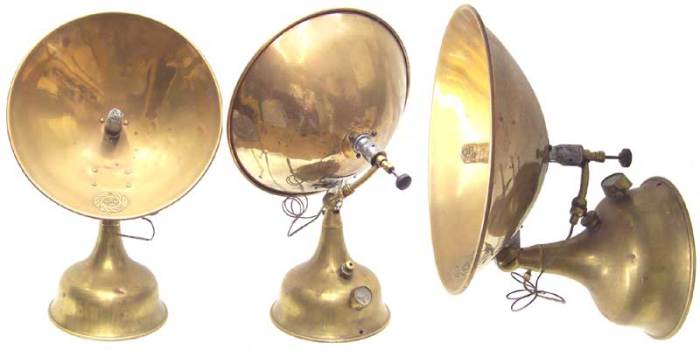
The Lilor brand included this Model 4062 radiant heater which is in Neil McRae’s collection. This heater is missing the wire guard. It includes a built-in pressure gauge but requires a separate pump. It can also be pivoted for wall mounting which necessitates the flexible external fuel tubing.

Kerona, a New Zealand company, likely made this radiant heater which is also stamped Lilor, a French company that probably made the upper heater parts for Kerona (Neil McRae). The heater is in Dane Gernecke’s collection in New Zealand. The heater is missing the cap to the silent burner.

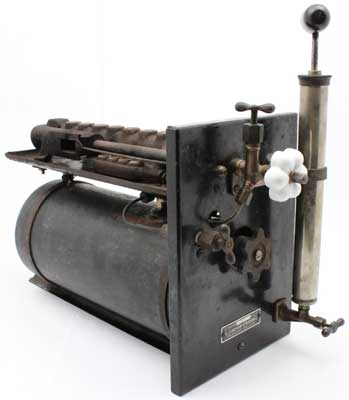
The A.J. Lindemann & Hoverson Co., Milwaukee, Wisconsin, made this Model 60 gasoline fueled heater in their Kerogas brand. Mike Loizzo, whose collection this is in, believes this model dates to the late 1920’s. The heater core (right image) slides out for fueling and maintenance. The fuel filler cap is the large knob in the lower center of that image.


Lindemann & Hoverson also made this Model 175 gasoline fueled radiant heater around the same time as Model 60 above which has a very similar burner assembly. Model 175 lower image) has a larger heating surface with five ceramic radiants rather than four as on Model 60. The top of the case (middle image) has a series of openings to help disperse heat. A large handle that rests behind the case (upper and middle images) makes it easier to move this heavy appliance. Both of these models are instant lighting. This heater is in John Tuckey’s collection.
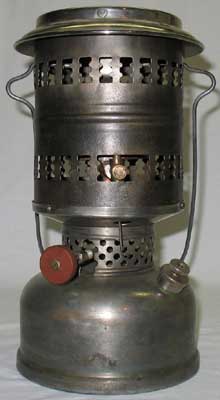
National Stamping & Electric Works, Chicago, IL, made this No 1 heater which was a variation of their early one-burner stove models in the 1920’s. George Rocen, whose collection this is in, made a replacement bail that is close to the shape and size of the original.

Aktiebolaget Optimus, Upplands Väsby, Sweden, made this Model 703F radiant heater. The reflector was available in polished brass as well as nickel plated brass as seen here (hence the F designation in the model number). The fount holds four pints of kerosene for the silent burner on this appliance. This heater is in Christer Carlsson’s collection.
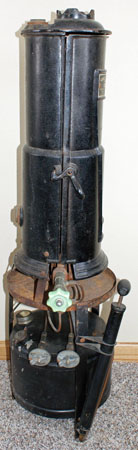

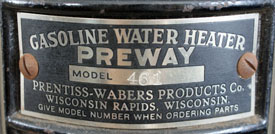
The Prentiss-Wabers Products Co. included this Model 461 instant lighting water heater in their 1938 catalog. The base of the water heater was a utility heater, comparable to a Coleman Handy Gas Plant, with 6 1/2″ slotted burner head, one gallon fuel tank, combination fuel and pressure gauge, and dedicated pump. Water enters and leaves the heater through port on the lower left and top of the unit (upper left image). The coils are 15′ of 3/4″ copper tubing. John Rugotzke, whose collection this is in, used a wood block to raise the copper coils to the correct position (upper right image).
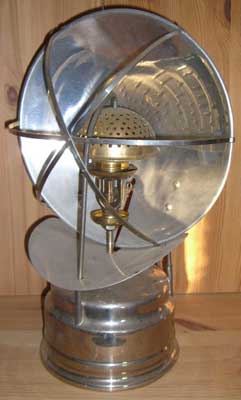
Aktiebolaget Radius, Stockholm, Sweden, made this Model 33 large fount radiant heater.
This unfired appliance, in Bo Ryman’s collection includes the wire guard.

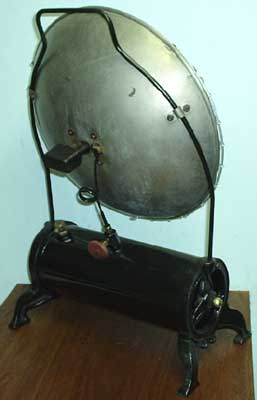
This Red Ball Brand petrol gas radiator, in Albert White’s collection, was distributed by T.W. Sands, Melbourne, Australia, and was advertised from 1929-1838 (Anthony Trueman). The heating element is copper.
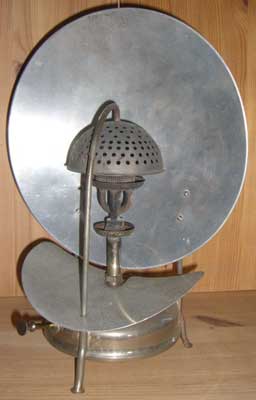
Sievert of Sweden made this Model 35 SVEA heater, that uses the tank and burner from a tripod stove. This heater, in Bo Rymans’ collection, is of unknown age.
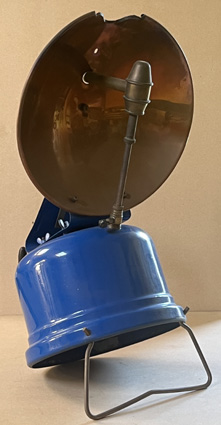
In 1954 Tilley introduced the IF54 infrared heater. The burner and reflector were at an angle compared with the fount and the heater could be suspended from a chain at various angles. Tilley advertised it for “all young animals” and often this was for keeping pigs or chickens warm. Anthony Trueman, whose collection this is in, noted that it was commonly referred to as a ‘pig heater’. The IF54 was the first Tilley heater to have a metal mantle and it also came with a smaller cycle pump filler cap or an optional pump.
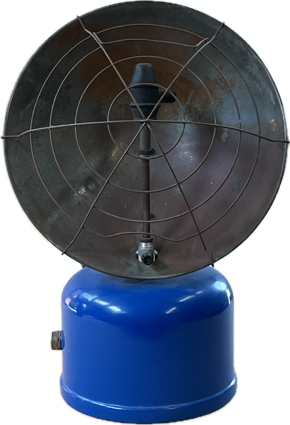

Tilley made this improved infrared heater, model IF542, in the late fifties. It followed on from the Tilley IF54 model (see earlier image) and both were a strong royal blue color. The burner and reflector in the IF542 were restored to a vertical position in relation to the fount and a Tilley R55 pump was standard. This heater, in Anthony Trueman’s collection could still be hung in multiple positions.


On this early Tilley R1 heater the ends of the wire guard pass through the front of the aluminum reflector rather than entering from the back of the reflector as on R1 heaters that were made more recently. The burner on this early heater is also different from the cast iron burners on later R1 heaters. This version of the R1 heater appears in a Tilley advertisement dated Nov. 1925. The optional heater plate heats slowly and doesn’t get very hot. This R1 heater is in David Shouksmith’s collection.

This Tilley R1 Model radiator dates perhaps to the early 1930s. The ends of the wire guard enter the reflector from behind. The burner is cast iron. The knob (right image) is a tip cleaner; there is no valve knob on this early version of this model. This early radiator, in Neil McRae’s collection, has not been restored.

Tilley made a number of radiator models in the UK. This Model R1 dates to the late 1930’s. It is the only R1 finished in chrome plating on the fount that Neil McRae, whose collection this is in, has seen.

Tilley made the R1 heater during WWII with steel founts as on this heater in Iain Sedgman’s collection. The control cock is brass, which was less common in this period. A previous owner added two screws to the top of the fount that can just be seen at the lower corners of the copper reflector. Iain reproduced the fount decal, painted the steel wireguard, that was unfinished, with copper paint and the fount with silver paint that is close to the original finish to prevent corrosion.


Tilley Model R1 radiator was manufactured in several versions after WWII. The pre-1950 version (left) had a copper reflector and brass fount. The wire guard on this was home-made. The 1950-54 version (right) has the painted fount, plated reflector, and retains the wooden handle (see insets in both images). These radiators are in Steven Lucas’s collection.
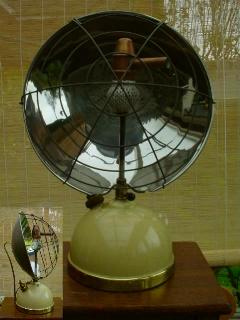
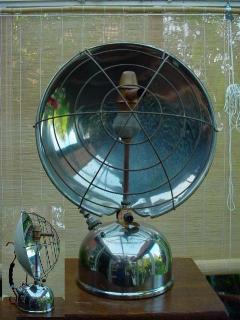
By 1954-56 (right) Tilley stamped “Tilley England” on the side of the R1 fount. Note the handle (inset) is flat metal. Lastly an R1A dated Dec. ’61, with all chrome-plated metal parts, and a plastic grip on the metal handle. These radiators are also in Steven Lucas’s collection.

This Model R2 dates to the 1930’s. It has a 2.5 Imperial pint brass fount to supply fuel to the two burners. This radiator is in Jeff Johnson’s collection.

Model R22 is another two burner model radiator. This model replaced the R2 (above) in the early 30’s and was replaced by the R46 (below) in 1946. This one is post 1940 based on the valve units; it is in Neil McRae’s collection.
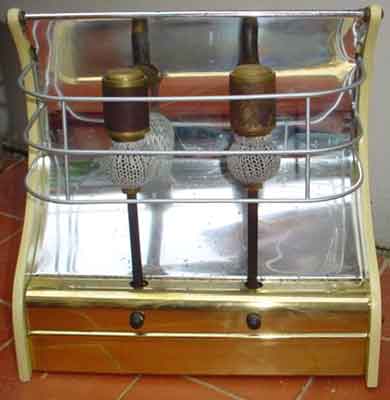
Another Tilley radiator, this is Model R46. This working heater is in Steven Lucas’ collection. Steven repolished the front brass panel and repainted the side panels in this post WWII two-burner model.


In 1954 Tilley offered Model TC549, a wickless, gravity fed convection heater (upper right image) that is paraffin (kerosene) fueled (Jim Dick). The fuel valve is on the lower right side of the cabinet. The cabinet is 28″ H, x 19″ W, x 10″ D. The tank (upper left image) fits in the left side, rear of the cabinet. The burner (bottom image) is embossed Tilley Hendon. This heater is in Terry Pownall’s collection.

Tilley radiator Model RH57 came in a variety of colors including black and green. The fount on this one, in Neil McRae’s collection is a pale gray. Model RH57 dates to the late 1950’s and is an upgraded version of the R1 with a stand to help aim the heat and a fancy grill.
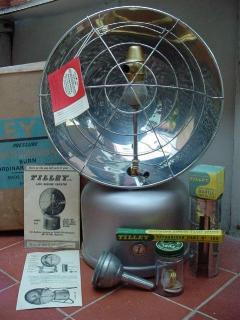
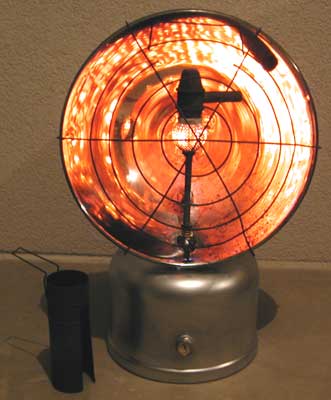
Two Tilley Model R55 radiators – dated Dec. 61 (left) and Aug. ’59 (right). The model on the left is seen as new with all the bits/accessories. The mantle is woven asbestos. The draught shield (right image) helps to preheat the vapourizer; access to place/remove the shield is through a hinged loop in the wire guard. A fuel gauge is mounted in the lower front of the fount. The R55 on the left is in Steven Lucas’s collection; the one on the right is in Mike Bullis’ collection.
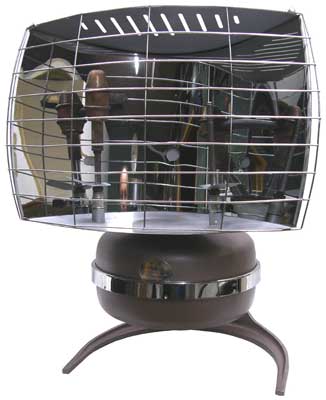
This Tilley Model HRH2 heater was almost certainly sold only by the A. W. Thacker Co., the US Tilley distributor according to Neil McRae, whose collection this is in. Neil dates this model to the early 1960s, based on the style of the control cocks.

Tilley Model LD1 (left) and LD Mark II (right) leak detectors. A flexible hose, as on the model below, allows the operator to detect a leak of methyl chloride, used as a refrigerant. The burner at the top has a ring of flame that changes color if a leak is present. These are in Neil McRae’s collection.

The Tilley Model LD2, another leak detector, but also functions as a blow lamp to solder the leak. Neil McRae got this leak detector from Australia. This is the only Tilley product/model that does not run on kerosene; it runs on alcohol.


Tito Landi, Paris, France, made this alcohol (spirit) heater that is in Agostino Del Coro’s collection. A small amount of pressure forms as in this Tito Landi lantern. In this heater, several fuel jets are aimed at the burner core (lower image) and generate the pressure to run the heater.
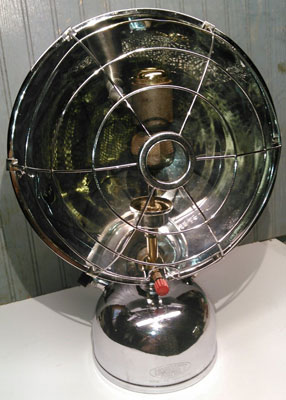

Union Metal Works, Hong Kong, made this kerosene radiant heater in the style of a Tilley but with a “petromax” filler cap/pressure gauge. The pump handle (left rear) is a replacement. This heater is in the Provost/Paradis collection.


We don’t know the company that made this Windsor Style 8 heater for Montgomery Ward, although the pump resembles those made by AGM. The pressure gauge (lower image) is labeled REPS, Clyde, Ohio, likely the manufacturer that made that part. The radiator is instant lighting and has 4 radiants (upper image) that are each supplied by two burners from below. This radiator is in Cory Sneath and Julie Bradford’s collection.

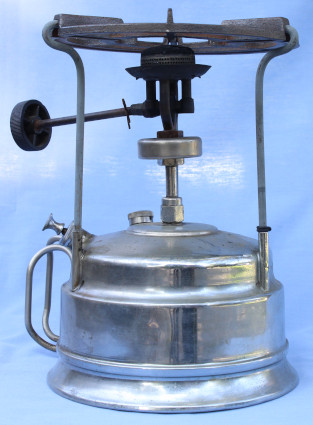
The only marking on this heater-stove combination is Aladdin which appears on the top of the cast iron stove grate. This appliance appears in an undated Australian ad, where it was found, but with no further details of the manufacturer. This appliance, in Logan Bourdon’s collection, has a silent burner.

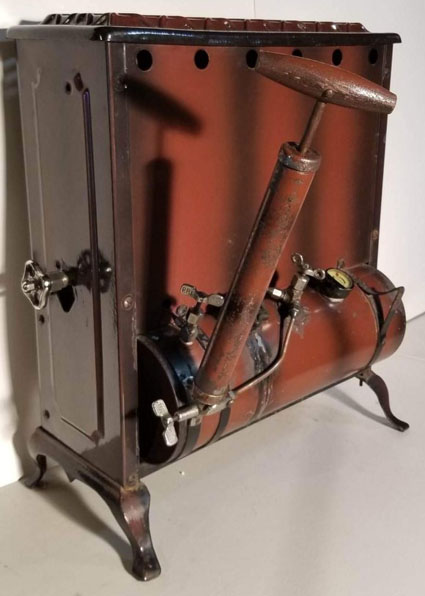

This gasoline radiant heater appeared in the 1928 – 30 Sears catalogs (Cantrell, McRae). It was made by the Wehrle Company, Newark, Ohio, before Sears bought that company. The heater has four wide radiants (top image), each heated by two burners. An unusual feature of the heater, in Jeff Studer’s collection, is the pump that can be pivoted from vertical to horizontal when not in use after closing the air valve to the left (middle image). The handle across the top near the back of the case to move this heater is missing.

© 2000-2026 Terry Marsh
 The Terrence Marsh Lantern Gallery