


American Camp Stove No. 1, made by the American Gas Machine Co., Albert Lea, Minnesota, was advertised in Catalogue 22, circa 1917. “…’the furnace in a bucket’…produces an intensely hot flame… and is especially popular with the carnival and amusement trade for warming pits, for lunch stands, as a candy cooker, etc.” This model, in James “Smitty” Smith’s collection, weighs 15 lbs. and holds 1 gallon of gasoline.

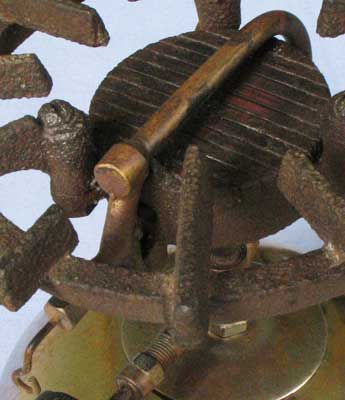
American Portable Stove No. 2 appears in AGM Catalog 22 circa 1917. The generator requires preheating; the generator is equipped with a tip cleaner. This stove is in James “Smitty” Smith’s collection.
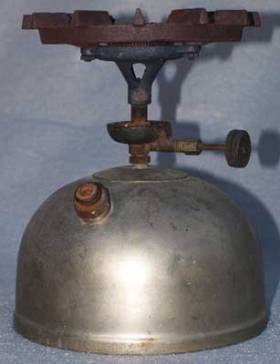

Kerokook Stove No. 5 is in Catalog 27 circa 1923. The silent burner includes a conical chamber with two air holes; the orifice is in the bottom of the cone. The burner design is for gasoline; the fount capacity is about 1 quart. This stove is in John Stendahl’s collection.

The American Gas Machine Co., Albert Lea, Minnesota, made this Model 20 Jiffy Kook gasoline fueled stove with a coil burner, circa 1918. The fount is initially pressurized by warming the fount with the heat of your hand around it once it is filled about 2/3rds with gasoline (Michael Hawks). This stove, in Steve Parker’s collection, came with the metal container.
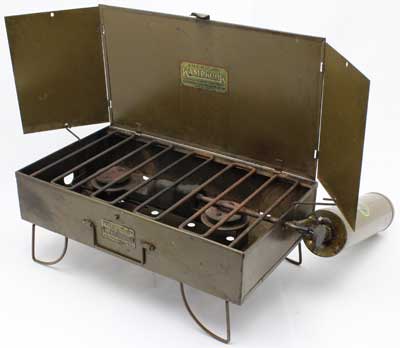
AGM Kampkook No. 1 stove appears in AGM Catalog 32, circa 1926. The cooking surface on this stove, in Bill Ryno’s collection, is 10″ x 17.5.” The tank holds 1 quart of gasoline, enough to operate both burners for 3 hours. With cast iron burners, the stove weighs 11 pounds.

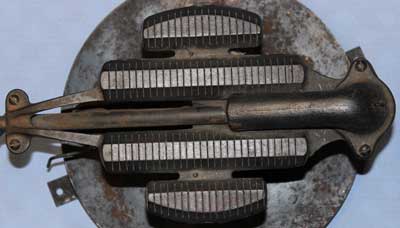
This Model 208C Heating Burner also appears in AGM Catalog 32. It could be mounted where needed; gasoline was supplied through copper tubing. The 6″ diameter burner (lower image) is preheated with the cup under the generator (upper image). The angled wire moves a door that regulates the air mixing with the fuel. This unfired Heating Burner is in James “Smitty” Smith’s collection.


This 810 Model AGM GalleyKook stove was likely made in 1926 for use on boats where the railing around the top of the stove would help hold pots on the cooking surface. The stove is equipped with two, 4 1/4″ burners (middle images). A pan under the burners (top image) can be slid out for cleaning. The valve key (above “A”, bottom image) is missing parts that made it easier to turn. This stove is in Chad & Chastity Holcomb’s collection.

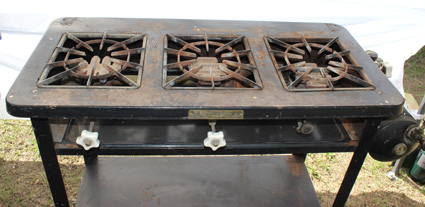
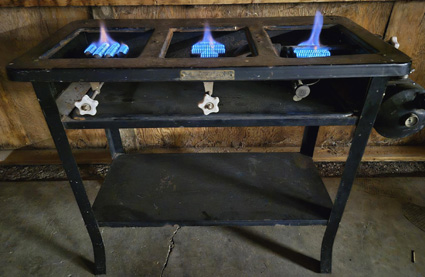
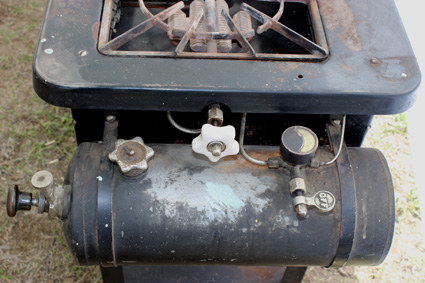
The American Gas Machine Company (AGM) 813 Kitchenkook range has three burners and a large tank on the right side. This petrol fuelled match-lighter range is in David Larson’s collection and is denoted as version 813B. The range is finished in black enamel. The removable burner tray is a blue-black porcelain finish. Generally, the range came with options; including a black backsplash with a pot shelf. A single or double oven could also be fitted to the 813 Kitchenkook.


The American Gas Machine Company, (AGM), manufactured the Kitchenkook model 833 stove being a three burner stove on a stand 32″ tall. A single large, one gallon, electrically welded tank, with a built in pressure gauge was attached. The Kitchenkook burned petrol and had a match-lighting generator on the rightmost and master burner (see lower image). This stove, found in the USA, is in William Klitzman’s collection and is all black enamel, bar the top piece surrounding the grates being a deep blue enamel. It came with a white porcelain removable burner tray. Some model 833 stoves were advertised in Australia with a white enamel splash-back and mantel.


This Model 922 KitchenKook dates to 1930-31. Note that the burner on the left is positioned higher than the master burner on the right (upper image) since it can only be turned as high as the latter burner. Both burners are controlled by the valve at the back of the tank (lower image) while the white ceramic valves control the individual burners. The black fiber carburetor valve at the front of the tank is for instant lighting the main/right valve.The drip pan below the burners is pulled out to be more visible. This stove is in Mark Uidenich’s collection.
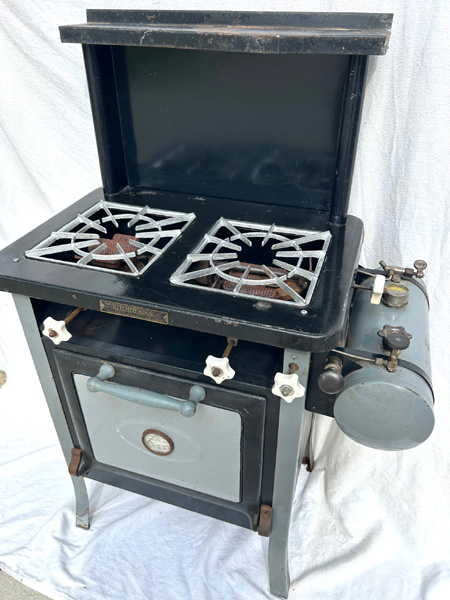
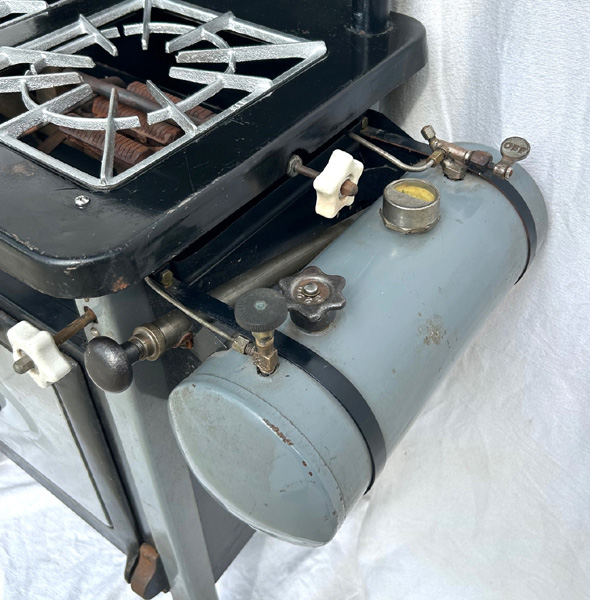


This upright Kitchen Kook 952-B range has the usual Kitchen Kook features including the electrically welded steel tank and removable grills. The burners are stated to seldom carbonize up and burn with a nice flame as can be seen in the 4th image. This Kitchen Kook is believed to be from the mid-1930s and is in Bill Klitzman’s collection. He stated that whilst the original drip tray and oven burner are both missing, the top two burners and the tank pressure gauge are all operating.
The height to the top of the cooking surface is 32” and it is 45” to the top of the back splash. The oven is about 46 litres (1.6 cu ft.) capacity and the entire unit weighs about 56 kg (125 lbs).


This Peerless brand W-M-P corn popper uses an AGM 204C Heating Burner (middle image) that appeared in the same catalog as the 208C burner above. The 204C is smaller; the outer diameter of the ring is 4 1/2″. The burner is fueled by a gas tank (bottom image) that is accessed from the other side of the aluminum case. Note the funnel for filling the tank in the lower image. The dimensions of this smaller corn popper are 26″ long x 18″ wide x 16″ deep. When opened, the lid provides a place to bag and display the popcorn (top image). Compare this popper, in Cain Kremitzki’s collection, to a larger Peerless popper click here.


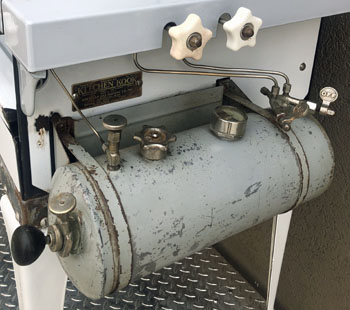

AGM Catalog 32 also included this Model 873 match lighting KitchenKook. This range includes four cooking burners, an upper oven, lower broiler (bottom image-running) with the KitchenKook badge (second image), and a cutlery drawer with a removable tray under the burners. The fuel tank (third image) has an integral pump, pressure gauge, and separate controls to the generators for the oven and cooking burners. This range is in Fred and Courtney Swiatek’s collection.
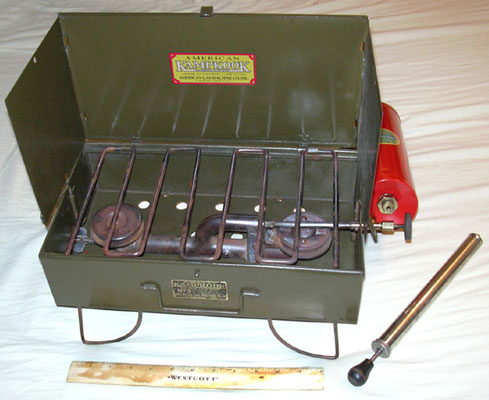

KampKook Model 3 was made by AGM in two versions – as seen in Randall Adams’ collection with curved retractable legs and a hinged top (upper image), and with straight retractable legs fitted in the corners and a separate top (lower image). The stove in the lower image is in Mike Morgan’s collection.


AGM Made their No. 1 Kampoven in the mid-1920s. All the parts including the stove, here a Model No. 3, fit inside the oven for transport. The two piece windscreen (lower image) also serves as a cover for the oven. The oven came with baking and frying pans and sold for $5.50. This oven and stove are in Clayton Heiderich’s collection.


The No. 4 stove included a “large warming shelf and folding windshield protecting flame on three sides. Windshield folds flat in cover when not in use.” (AGM Catalog 27, 1923) The right windsheld is folded back to see the tank and valve. The AGM stand with dull nickel finish supports the stove nicely (lower image). This stove, in Jan Dyke’s collection, came with the wrench.

This is an early two burner stove, Kampkook Model 6, made by the American Gas Machine Co. The lid (not shown) is detached from the stove when in use. The separate pump is shown on the pumps page. This stove is in Brien Page’s collection.

AGM Kampkook Model 9 is the same construction as Model 3 above but the case is made of brass rather than steel. Tom Talburt, whose collection this is in, found no evidence that it had ever been painted. The stove tag has a patent date of 1921 and it appears in a 1923 catalog, where it was advertised as “Especially recommended for use near the seacoast.”

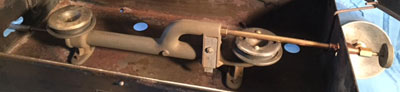

The No. 7 stove appeared in a 1924 magazine ad. It featured folding windscreens as did the No. 10 lower on this page. This model requires preheating using the fuel cup below the master burner (right, in the middle image). The tank top on models of this era had a built-in funnel (lower image) This stove is in Devon Pym’s collection.
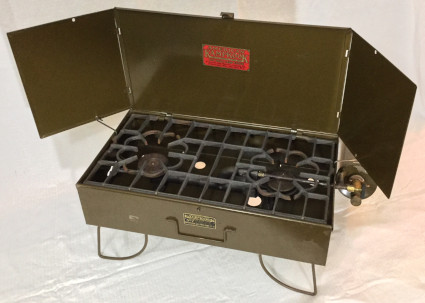

Two differences between this No. 7 stove, circa 1928, and the earlier No. 7 stove above are the grate, that is now all casting, and the extended pump (upper image) replaced the filler plug that required an external pump. The first several of these “suitcase” camp stove models that AGM made in the 1920s had a hanging tank. The warning tag on this tank is in nearly-new condition (lower image). This stove is in Bill Whitten’s collection.

The Model 8 stove dates to the mid-1920s. It is distinguished by a built-on pump on the tank and an integral oven. Note the heat diffuser that sits on the cast iron grate. The cooking surface is 19 1/2″ x 10 1/2″. This stove is in Larry Hillhouse’s collection.

Kampkook Model 10 has three burners and a cast iron grates This stove is in Brien Page’s collection. As Model 6 above, Model 10 was in the 1923 AGM catalog, and required a separate pump.
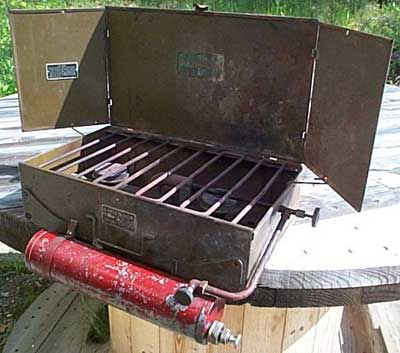
The Model 44 Kampkook stove by AGM appears in a 1930 parts catalogue. This stove has been in James Davis’s family’s possession and was probably purchased new by his father. It was used on family camping trips until the 1960’s and still operates.

This Model 11 instant lighting stove appeared in Catalog 37 in 1932, two years after they introduced 3 instant lighting models: 77, 88, and 99. The black fiber angled valve to the left of the green letter “A” is opened for instant lighting with a fuel-air mix then the red fiber horizontal valve is opened below the letter “A” to supply only gas for running once the stove is lit. Once the stove is running, the black valve is closed. This stove is in Carlton Blanks’ collection.

AGM probably made this Kook Rite instant lighting stove for Sears circa 1930. Instant lighting is accomplished by the angled valve wheel just to the left of the case and over the end of the tank. Bob Nichols matched the dark green, nearly black original paint to repaint the stove.


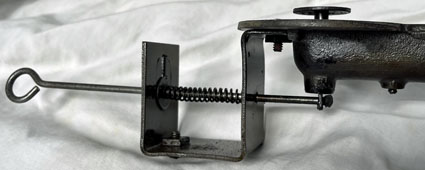
AGM made this 4X Camp Cooker sometime after 1930 as the stove is instant lighting (you can see the two valves in front of the tank in the top image). It has the same burner as the AGM KookRite for Sears above. The master burner (third image down) also includes a square cup below the end of the generator for preheating. The slave burner (fourth image down – burner parts removed) is opened by lowering the rod to the left which raises the cap to release the fuel-air mix. You can see that the Preway company used this same mechanism here. This stove is in Keith Gantt’s collection.
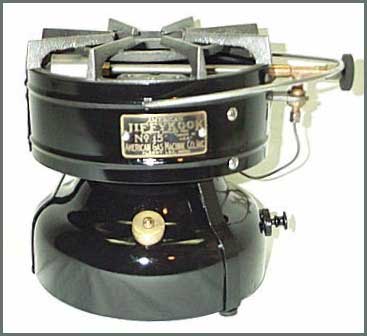

Model 15 JiffyKook by AGM shared the fount that was also used on some of their lamp and lantern models. This stove appears in the 1930 and later catalogues. An earlier version of this model had a cast iron burner as on Model 18 below. While it is a one-burner model it is 9″ tall to the top of the burners, 10.5″ in diameter at the valve and weighs 7 pounds empty! George Rocen restored this stove which is in his collection.

AGM Model 18 JiffyKook is very similar to Model 15 above and came with the same burner as seen here in Cat. No. 40 from the mid 1930’s. The pump and the length/placement of the fuel line after the valve are the only apparent differences between this model and Model 15. Drew Meyer restored this stove for his neighbor, Dave Puetz.
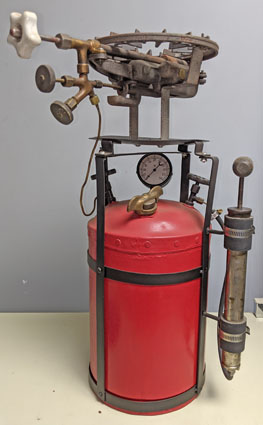
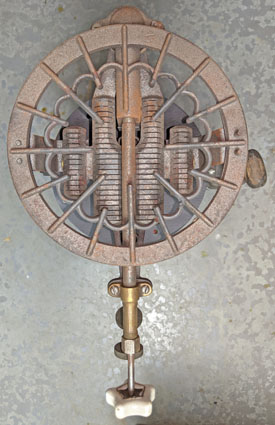

This AGM No. 135 Utility Burner appeared in the 1930 Parts Catalog. The burner was mounted on a frame above a fuel tank with a pump mounted on the side (top image). While the white porcelain valve (C – bottom image) controls the heat output the valves below, valves A & B are described as a cut-off valve and regulating needle respectively. A preheater cup is located above D. Loren Abernathy restored this utility burner that is in his collection.
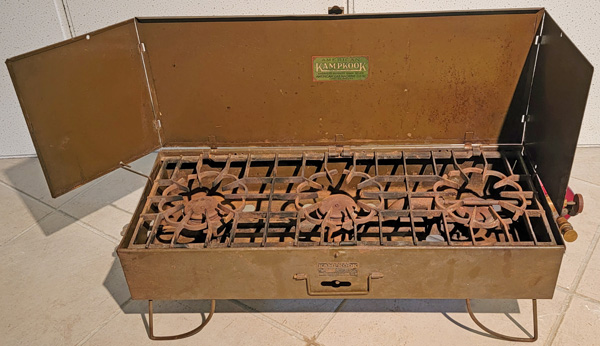
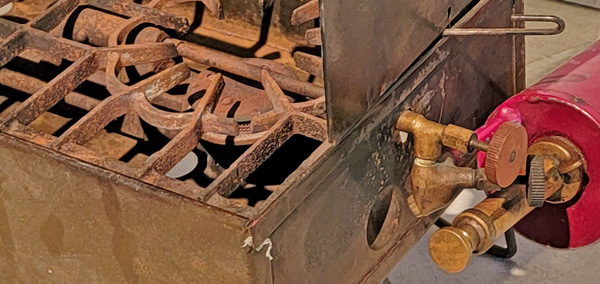
AGM also included their Model 99 three burner KampKook in the 1930 parts catalog. This instant lighting stove has a tank that can be hung from the case as on other models of the period. The master burner is on the right (lower image). Note the short windscreens. The middle burner is regulated by putting a key in the opening in the lower middle of the front of the case to turn the valve (upper image). This camp stove is in Sean Duncan’s collection.
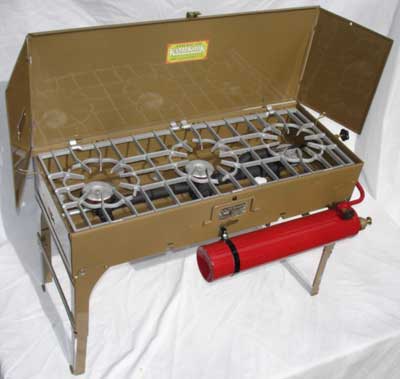
AGM Catalog No. 40 identifies this No. 57 KampKook as a 1933 model. The master burner is on the right; keys that pass through the front and left side panels operate the other two burners. The cooking surface is 26 x 10.5″. The legs can be extended an additional 5″, to 18″ height, as seen in the above image. Doug Hodder restored this stove that is in his collection.

This Model 55 KampKook stove is also shown in AGM Parts Catalog as a 1933 model. It has a preheater cup below the right (master) burner so isn’t instant lighting. This stove is in Sean Duncan’s collection.

© 2000-2026 Terry Marsh
 The Terrence Marsh Lantern Gallery