

Aladdin Industries PTY Ltd, Waterloo, Sydney, Australia, made this type of Aladdin Two Burner kerosene stove circa 1950. The stove could be purchased for indoor use (upper image) or outdoor use (lower image) with a carrying case that included windscreens that were partially supported by the case. In later production, as on the top stove, the fuel lines from the tank are curved upwards to meet the burners. These stoves are in Iain Sedgman’s collection.


This Tourist Camp Stove was made by the Albert Lea Foundry Co, Albert Lea, Minnesota. Unusual features of this stove are the cast burner parts that include a depression in the master burner to hold fuel for preheating (lower image). The stove, in Mark Burnett’s collection came with a pump, that can be seen on this page, and a wrench that can be seen here.

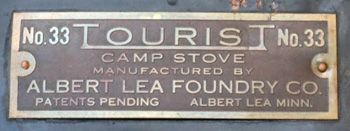
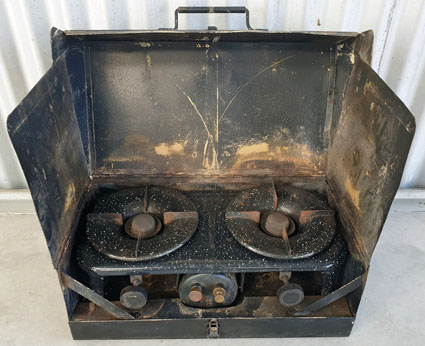
This No. 33 Tourist stove was also made by the Albert Lea Foundry Co. John Stendahl, whose collection this is in, only found it advertised in 1925. The lid can serve as a drip pan during operation; there are no separate windscreens. The stove requires a separate pump, requires preheating, and runs on white gas. As on AGM stoves of the period the gas tank on this stove hangs on the right side of the case or can rest on the same surface as the stove as seen here. The Albert Lea Foundry Co. also made room and water heaters.


This version of the Albert Lea Foundry Co.’s stove has features of both of the above stoves that are badged for their company but this one is badged for the reseller Montgomery Ward (bottom image). These stoves date from the 1920s and were preheated. Burning the gasoline in the cap above the main burner on the right preheats the generator then the fuel valve can be opened to run the stove. This stove is in Bill Klitzman’s collection.
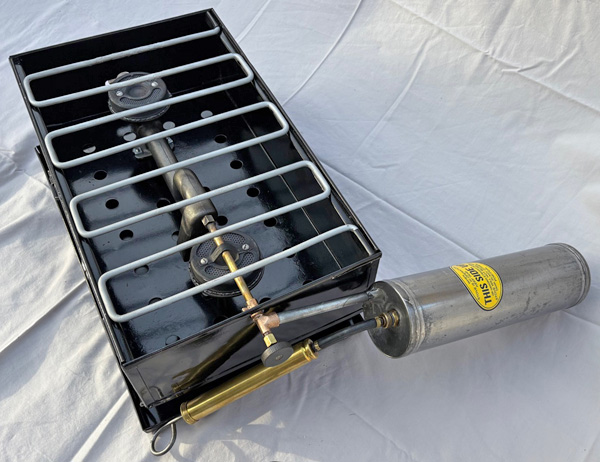
This is likely an earlier version of the Albert Lea stove for Montgomery Ward than the one above. Note that the case top is separate from the rest of the case so can be put under the stove to catch drips. The pump for this model, in Keith Gantt’s collection, threads onto the tank’s filler plug to pressurize the tank. This version of the stove lacks windscreens.

This M-1942 military stove is stamped A.P.C. (Armstrong Products Co., Huntington, West Virginia) and is dated 1974. The stove and its parts fit in the sterilizing box on the top of the stove. The stove, in Roger Hill’s collection, is comparable to Coleman’s Model 523. They were made under military contract by several manufacturers between 1943 and the early 1990’s.


The Auto Camp Stove was built by a company of the same name in Ft. Wayne, Indiana. The company was in business for several years beginning in 1918. According to a 1919 issue of Motor Boating magazine, the case is a “standard size Ford tool box”; the stove is meant to be removed from the box to operate. Steve Wagoner restored the stove including matching the paint to the original colors.
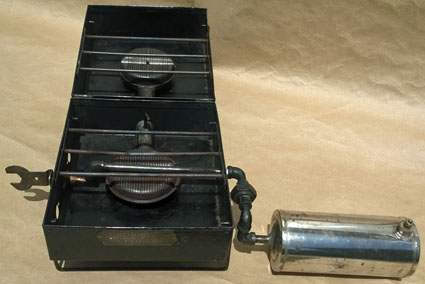
The badge on the front of this stove identifies this as a Gates Folding Stove, patented in 1915, and made by the W. J. Baker Co., Newport, Kentucky. The front and back halves fold together to form a box that is 9″ x 8″ x 5″. The tank pivots at a union that is tightened by the wrench-valve key and rests inside the stove for transport. The second (rear) burner is controlled by a baffle with an “L” shaped lever that can be opened to allow the fuel-air mix to reach the second burner. This unique stove is in Reese Williams’ collection.


Gustav Barthel, Dresden, Germany, made this Juwel brand No. 6 kerosene fueled stove, perhaps circa WWI when brass was in short supply, as parts of the pump are steel rather than brass (upper image). Note that it is also marked Made in Germany in the upper image. The flame spreader (lower image) has three short legs to allow the fuel to burn between the posts in the burner. This stove is in Doug Dwyer’s collection.

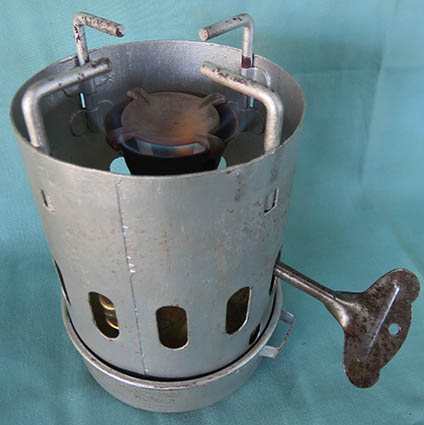
Gustav Barthel, also made this Juwel brand Model 33 Benzine (gasoline) stove probably after WWII. The steel carrying case also holds a pot over the flame (lower image). The stove can be pressurized by burning a small amount of gasoline in the depression around the base of the burner (top image). This stove is in Mario Fourie’s collection.


Another Juwel brand stove, this Model 21 is kerosene fueled. This stove, in Mario Fourie’s collection, came with a windscreen to aid preheating (upper image), a nut to close the tank when the burner is removed for transport, three legs and a metal tin (lower image).
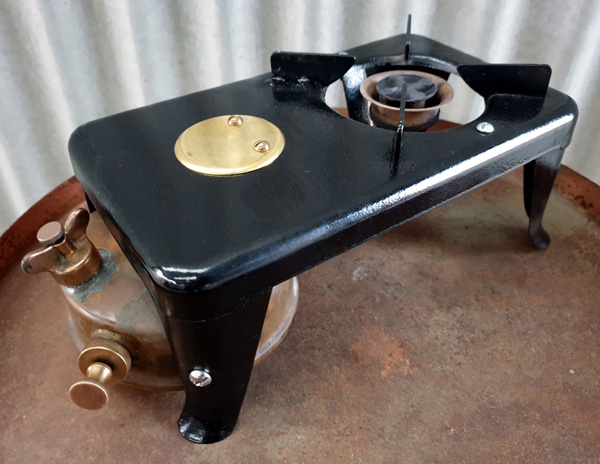
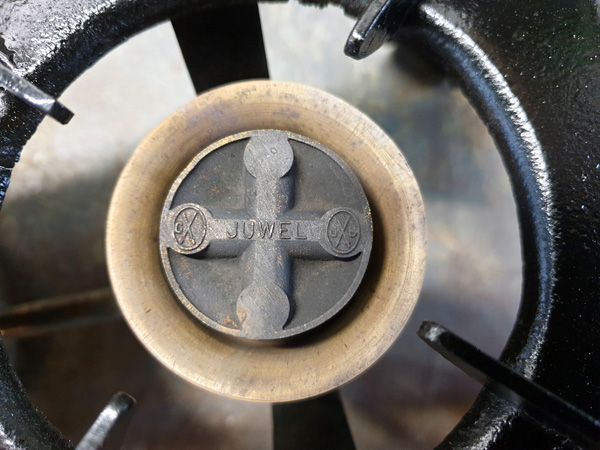
Gustav Barthel, also made this Juwel 109 stovetop cooker which has a half litre tank located under the stovetop. The burner is a roarer type with a conical thread. Run time on a tank of fuel is about 1.5 hours. The stovetop measures 15 cm by 25.5 cm. The brass plaque is a replica of the original which read Juwel.

This British Parasene brand stove was made by the M. H. Berlyn and Co. This two pint stove is stamped Parasene on the top of the tank. Iain Sedgman, whose collection this is in, painted the steel grate black. This part is embossed Parasene and British.

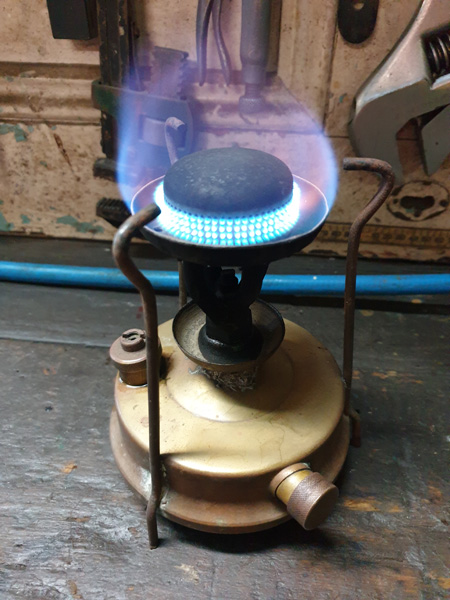
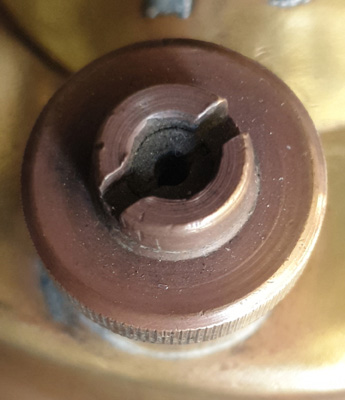
This Parasene ‘Safety’ stove made by M. H. Berlyn & Co is an unusual ½ pint stove with a full sized silent burner on a smaller tank. The only stamping is on the small pan support reading ‘Parasene’ and ‘British’. A few versions of this stove exist. An actual model number for this stove has not been identified to date. The filler cap has a built in safety valve that should be left well alone according to the manufacturer. The stove, from the Sedgman collection, is commonly said to run very hot.
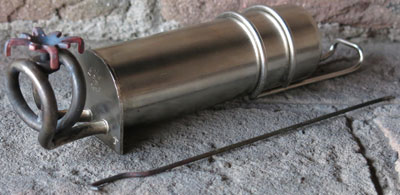
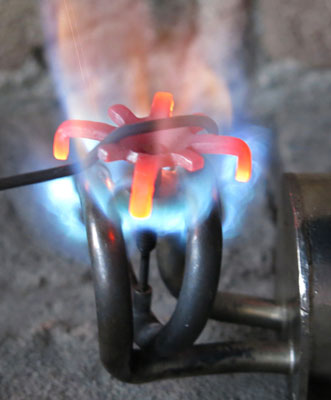
The Borde Benzin Brenner (gasoline burner) was developed in the early 1950’s by Joseph Borde in Zürich, Switzerland. The coiled generator/burner on this Model 33 stove is regulated by turning the starred wheel with a metal pick (lower image). Fuel escapes from a small opening in the bottom of the coil and burns when it hits the underside of the starred wheel. This stove is in Ian Keates’ collection.
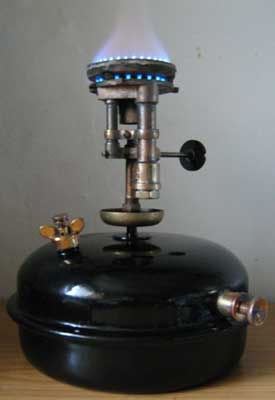
British Petroleum Co., Ltd., London, England, made this Cleary “B P” stove, which was named for its inventor, Edwin Cleary, who patented the burner in the early 1920s. Henry Plews restored this heavily used appliance in his collection to close to its original appearance.

Clayton & Lambert, a Detroit, Michigan, company, filed the patent for this Model 3 stove in 1926, the patent was issued in 1931, and the stove is marked Patent Pending. All of this 3 burner model, including the stand, folds down to 29″ x 12″ x 7″. A high-end model, it features pilot lights for the 2 side burners, a pullout gas tank on sliding rails that self lock in the out position, and attached flip-up grates for each burner to ease cleaning; the flame guide surrounding each burner lifts off for cleaning. The stove cooks evenly on all burners and is thrifty on fuel. The stove is in Mark Rutledge’s collection.
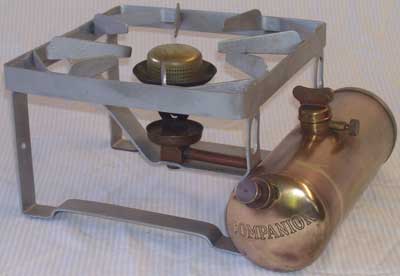
The Companion Heater Pty Ltd, Melbourne, Australia, made this stove under license from Max Sievert, Sweden, sometime after 1939 (Watchom, from the Classic Camp Stoves website). This is Model 53 as it has a right hand side tank and silent burner (Sedgman). This stove is in Peter Cunnington’s collection.

The Companion Heater company also made this kerosene 5C stove with a silent burner. It was sold with parts to convert it to a heater. This model is unusual in having an aluminum ring to which the three legs are attached. The ring on earlier 5C stoves is wider. This stove is in Iain Sedgman’s collection.


The Companion Company made this stove in 1960. An advertisement for this model appeared in that year according to Iain Sedgman, whose collection this is in. The 1 litre/imperial quart tank is covered by the plate between the burners that is held by 4 screws. Other features of this unidentified model, presumably 2B, include an air release screw in front of the tank, the supporting frame is mounted from front to back, and the burners are only supported by the fuel lines.


Companion presumably made this Model 2B-1 after the above model. This model features an automatic safety valve that has a visible hole in the upper brass fitting. The tank cover is held by 3 clips, there is a metallic red warning sticker above the safety valve, and the supporting frame is mounted from side to side and holds the burners. This stove is also in Iain Sedgman’s collection.
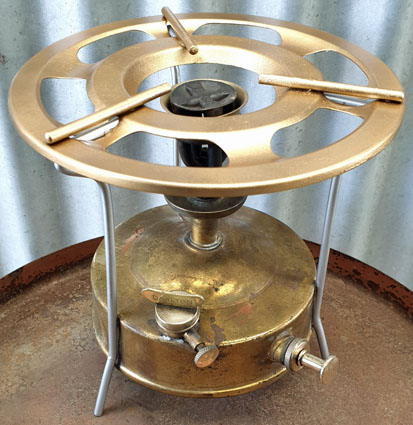
This kerosene fueled tripod stove was made in Australia and distributed by Darlton Products Pty. Ltd. Iain Sedgman, whose collection this is in, has learned that Australian companies during and after WWII had products made to compensate for a lack of suppliers for their part of the world in that period. It is unknown which of two factories made this standard design. It is only marked Darlton on the filler cap and burner and stamped No. (left blank), Darlton, and Australia on the side of the tank. Iain repainted the legs and grate on this stove.

This Model 733 Dura Camp brand stove was made by an unidentified Japanese manufacturer, possibly in the 1960’s. It has a number of similarities to Coleman stoves of the same period. This stove is in Brien Page’s collection.

Enders Colsman AG, Ludenscheid & Werdohl, Germany, made this compact Model 9063 stove, known also as “Baby.” This benzine (gasoline) model came with a pricker, funnel, wrench, and spare parts. The stove is stored in the metal box that also serves as a stove stand when in use. This stove, in Tim Tucker’s collection, was imported to the US by Gloy’s, a division of Amdis Corp.

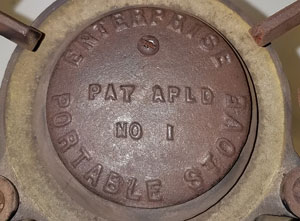
The Enterprise No 1 Portable Stove was manufactured by the Enterprise Tool & Metal Works of Chicago. It came with a detachable, external pump and a cast iron preheater cup below the burner. The lower image is of the markings on the burner casting. The decal on the fount notes that they also made auto tire pumps and gasoline & kerosene lamps. This stove is in Tom Reis’ collection.
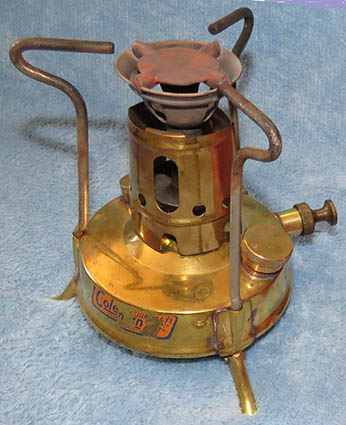


Falk, Stadelmann Co, London, may have made this paraffin (kerosene) tripod stove for Coleman UK. The stove is “Sol-Jun” No. 533E. The “lipstick burner” (upper right image) has a ring on which the flame spreader rests. The tank capacity is 1/2 pint and produces 2,700 BTU according to the product sheet. The wrench to seat the burner can be seen here. This stove and parts are in Logan Bourdon’s collection.
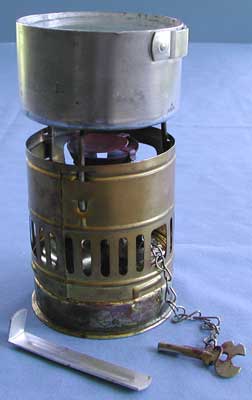
The only identification on this stove or the box (not shown) is Fire-Lite. The stove, seen here heating water, is a clone of the popular SVEA 123. Neil McRae notes that Fire-Lite is a South African brand that was used by Watcor Ltd., Capetown. Since Watcor made at least one tripod stove with a lantern head conversion under the Dolphin brand, they may have also made this stove. This stove is in Jim Lawrence’s collection.

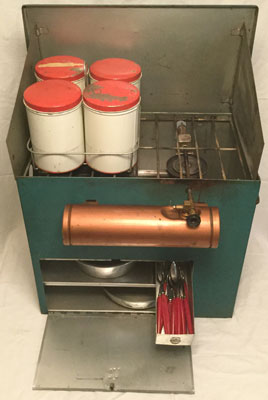
The Flinson Port-A-Camp Kitchen was sold by the Flinson Co., Kansas City, Missouri, in the mid-1950s. The appliance includes a Coleman burner unit, perhaps the same as in a Model 425 camp stove, with compartments containing canisters, coffee pot, cups, pots, pans, plates, and utensils The burner unit stores in the box. This appliance is in Bill Whitten’s collection.
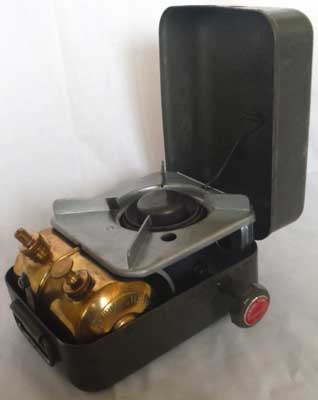
The Egil Fuhrmeister factory, Bergen, Norway, made the Fuhrmeister 8 stove for the Norwegian Army. This durably built stove weighs 2 Kg; 1/3 more than an Optimus 111. It can burn kerosene, diesel, or gasoline fuels. This stove is in Geir Wilhelmsen’s collection.
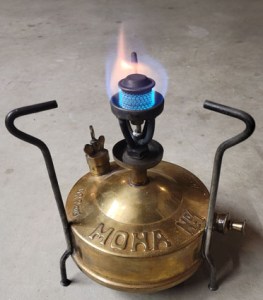
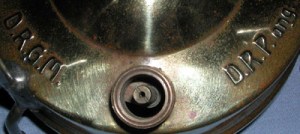
According to the Classic Camp Stoves website, this Moha brand No. 1 stove was made by Gebruder Bing, Nuremberg, Germany, prior to 1932. The NRV (non-return valve) is mounted inside the fuel opening (lower image) after a right angle turn beyond the pump well for access to maintaining that part. The embossing in the lower image refers to the German patent registration. John Rugotzke, whose collection this is in, found that it runs well on kerosene (upper image).


The Gloria Light Co. Pty. Ltd., Melbourne, Australia, made their Portable Stove Model 388 in 1938-39, according to Iain Sedgman, whose collection this is in. The Shellite (gasoline) stove requires preheating the master burner on the right by opening the valve wheel to the right of the instructional tank decal (pilot valve – upper and middle images). The end of the fuel tube (bottom image) is slotted. Burning the releasing fuel for 40-50 seconds preheats the generator so the main valve can be opened and the pilot valve shut.
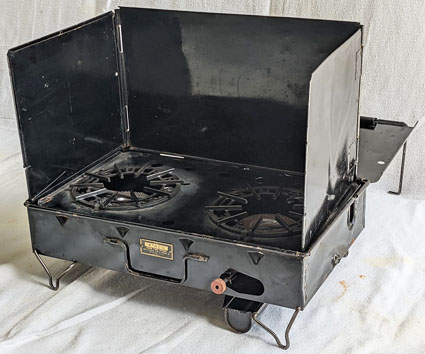

This Staco brand stove was made for a reseller by the Goldberg Brothers, Denver, Colorado, circa 1924-26, according to Reese Williams, whose collection this is in. The cast iron grates spell out the Goldberg Brothers’ Sure Fire Brand around the outer circle. This company used sheet metal (lower image) for the manifold earlier than other stove companies that used cast iron well into the 1930s. The valve wheel for the slave burner is articulated so it fits in the case (lower image). A metal cover protects the generator when the stove is stored. You can see the stove pump here.

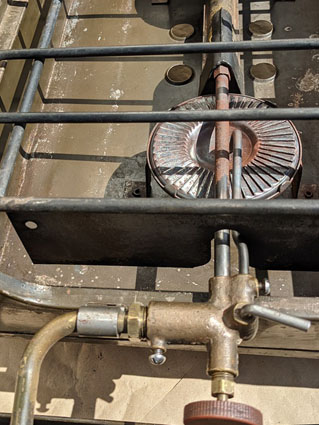
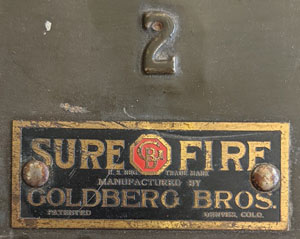
This Goldberg Brothers stove, is possibly their Model 2 (bottom image). Reese Williams, whose collection this is in, dates this model to 1926-27. As on the Goldberg Brothers stove above this one, the generator is protected by the metal cover when the stove is stored (top image). In the middle image you can see a shield that adds to the heat protection of the tank, and an “L-shaped” valve that controls the flow of fuel to the closer, master burner for preheating.

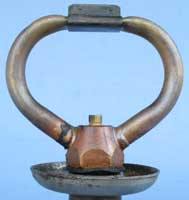
The Goodfire Stoves Corp, Valenzuela, Philippines, made this Model GP-1 stove. The burner (lower) is unusual in having a single loop for preheating the kerosene. This stove is used by Boy Scout Troop 194, Roselle, Illinois.

This is a Model 100 Petromax brand stove from Germany was made by Graetz Vertriebsgesellschaft mbH. It runs on kerosene and is preheated with alcohol which can be put in the cup via the hole beside the burner. The flame is regulated by pumping and bleeding air with the screw on the left.
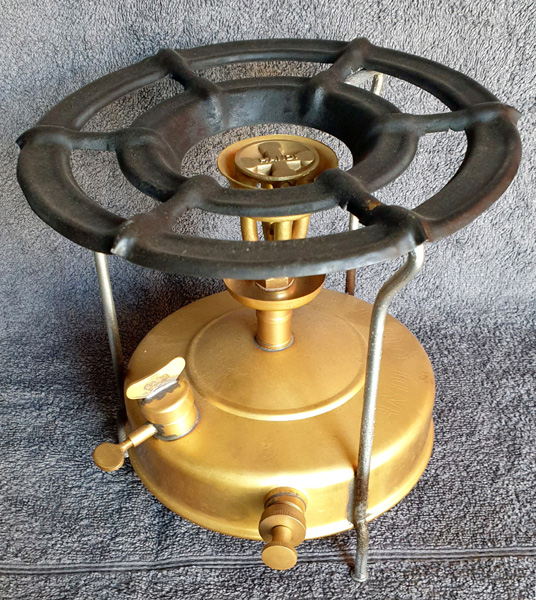

Handiworks Pty. Ltd., Brisbane, Australia made this Quick-Boil 1.5 pint stove. The stove was available with a silent or roarer burner. It is from the Sedgman collection.

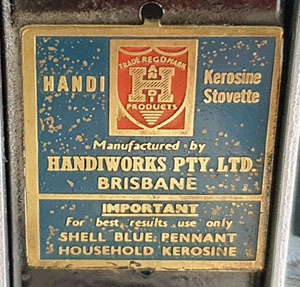
Handiworks Pty. Ltd., Brisbane, Australia (lower image) made this Stovette. This version was formed by joining two single stoves together at the factory. This stove has silent burners. Note the copper tanks with brass fittings. When Iain Sedgman restored his stove he refinished the original zinc coating on the frames with chrome paint and added some black painted parts for contrast.

Franz Heinze KG, Wuppertal, Germany, made this kerosene stove for the German armed forces. The stove is not removed from the carrying case to operate and is preheated with a Rapid preheater; there is no provision for alcohol preheating. This stove is in Bob Meyer’s collection.


The Hercules Manufacturing Co., Minneapolis, Minnesota, made this Model 1 Hercules Safety Stovette. The stove, in James “Smitty” Smith’s collection, came in the box (lower image) with the extensions (upper image), funnel, pump, and wrench. The funnel and wrench can be seen here while the pump can be seen here.

This Evinrude Camp Stove was made for Evinrude by Hercules Mfg. a smaller decal with the Hercules name shows through the Evinrude decal on the metal case. Hercules Mfg. sold the same stove (above). Larry Pennell, whose collection this is in, got the stove with the metal case, pump, pin, and funnel The pump screws into a valve/fuel cap on the back of the stove.
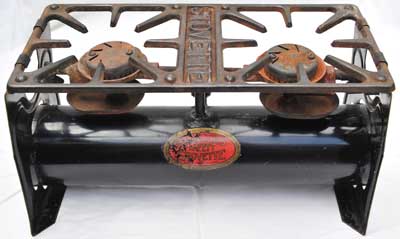
This Hercules Safety Stovette was also made by the Hercules Manufacturing Co. The decal on this stove and on the Model 1 Stovette above includes a patent date of May 18, 1920. This stove is in Jim “Smitty” Smith’s collection.
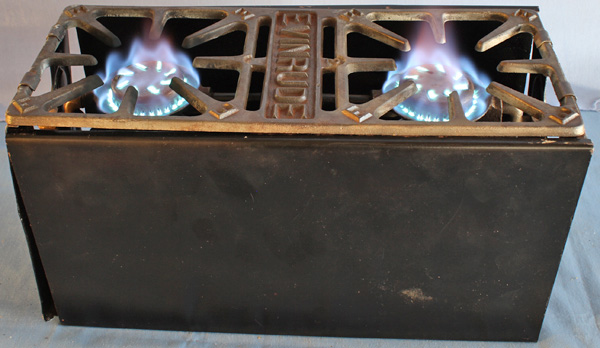
Glen Seresse’s Stovette includes a “U-shaped” windscreen (two sides and the bottom) to protect the flames when the stove is running, as in this image.

The Lea Hin Co. (Pte) Ltd, Singapore made this No. 2 kerosene tank to serve multiple stove (roarer) burners. The tank has a built-in pump, pressure gauge, and 2 fuel lines. While this tank is dated July 15, 1970, it and three other sizes are still for sale by the company. This kerosene tank is in John Rugotzke’s collection.

This B-101 roarer burner is the largest burner made by the Lea Hin Co. to be fed by their kerosene tanks as No. 2 above. The diameter of the cast iron flame spreader is 130mm. A primary market for these is in rural areas in Asia where they are likely used by food vendors for cooking. This burner is in John Rugotzke’s collection.
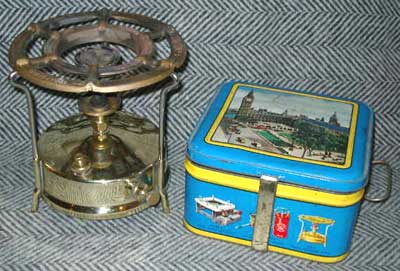
Lea Hin also made this Butterfly brand stove, Model 2411. This stove with its tin is in Bo Ryman’s collection.
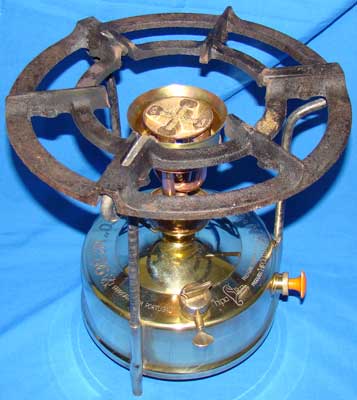
Casa Hipolito SARL once manufactured gas pressure appliances in Torres Vedras, Portugal, Their products included this Model 36 tripod stove that is in Pablo Vega’s collection. When he got it the cast iron grate was with the stove.

This Hipolito No. 2 stove, also in Pablo Vega’s collection, is unfired. The stove may have been manufactured in 1986, based on a printer’s mark on the box flap.
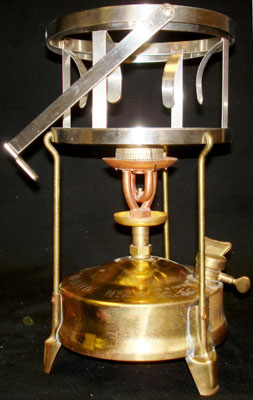
Another unfired Hipolito No. 2 stove, this one with a silent burner, hangs from a gimbal made by Force 10, so it can swing freely in a rocking boat. In the image the mounting bracket is hanging to the left. The inside of the mounting bracket has four rounded clips to hold a heating pot. This stove is in Bob Meyer’s collection.

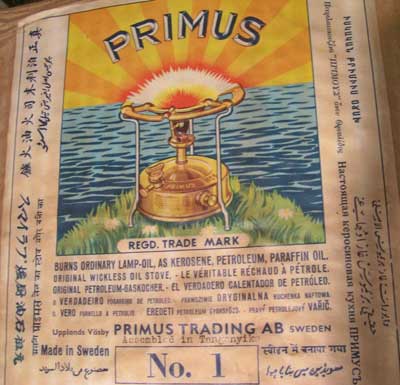
This stove, which is stamped “Sitima Asili No. 1S:or” and “Kaluworks Mombasa,” was likely not made in Sweden as the box (right) states. The label is also stamped Assembled in Tanganyika; the bottom of the box is marked Kenya Box Factory. Ross Mellows notes that Primus Trading on the box label makes it post 1962 and more likely of Optimus, not Primus, origin. This stove is in Glenn Knapke’s collection.
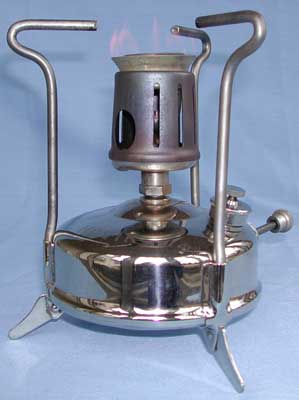
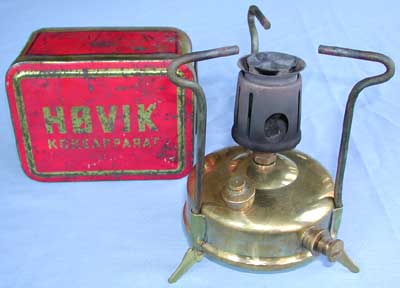
The Norwegian company, Hovik Verk, made these Model 41 stoves which are also stamped with their Standard brand. The one on the left, finished in nickel, is shown running. The end of the pump handle doubles as a plug when the burner is removed for packing in the tin.
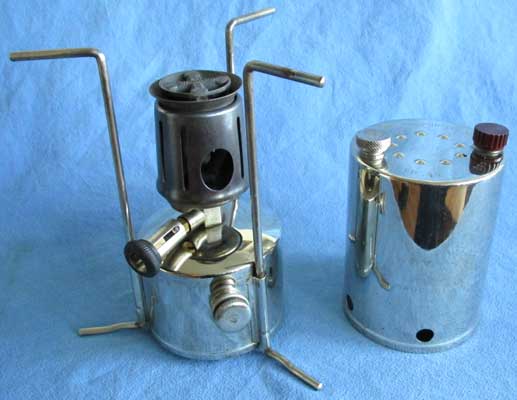

Hovik Verk patented their Standard No. 44 stove, producing & marketing it in the 1940’s. Geir Wilhemsen, whose collection this is in, notes they were only sold in Norway and marketed to motorcyclists. The fuel valve collapses for storage inside the case on the right. The case has storage compartments for kerosene and alcohol.
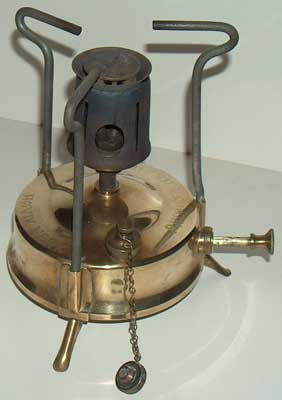
Hovik Verk also made this Model 210 stove under license from Primus in Sweden. The burner was supplied by Primus and is so marked. This stove is in Harald Hogseth’s collection.
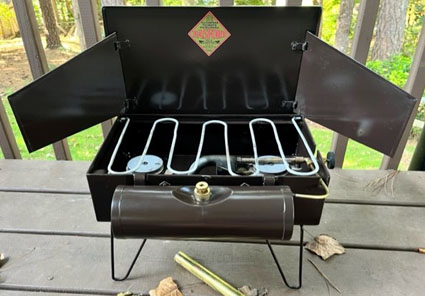

The Hugo Mfg. Co., Duluth, Minnesota, made this Model 4 Basford stove sometime after 1924 based on several patent dates on the label.This two burner model has a unique lever (“A”, lower image) to control the second burner and an erect lever (to the left of “B”, lower image) to divert fuel from the generator to the preheater cup. These stoves require separate pumps. This stove is in Keith Gantt’s collection.

This No. 0 Basford stove also requires preheating and a separate pump as Model 4 above, however, due to it’s small 14″ x 8″ grate surface, there is only one valve to control both burners. The stove also lacks windscreens and the top is not connected to the case but is held in place by the legs when the stove is folded up for transit. The top edge of the top is in the above image where you can see the indents that hold the legs in the storage position. This stove is in David Jewell’s collection.
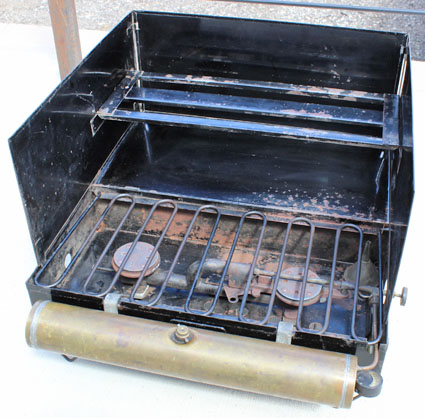

This No. 2 Basford stove is likely an earlier model than No. 6 below. The brass tank is stamped along the top: BASFORD CAMP STOVE HUGO MFG CO DULUTH MINN. The left burner is controlled by a flat key (lower image) that slides on the swaged shaft. This stove is in Mark Uidenich’s collection.


This Model 6 Basford stove was also made sometime after 1924, also based on the patent dates on the label. This two burner stove, in James Davis’s collection, includes a siphon to take gas from a car tank and a pressure gauge on the end of the tank. A warming rack is located above the cooking grate. The burner system on this stove is the same as the one on the Model 4 stove above including the lever to divert fuel from the generator to the preheater cup.

© 2000-2026 Terry Marsh
 The Terrence Marsh Lantern Gallery